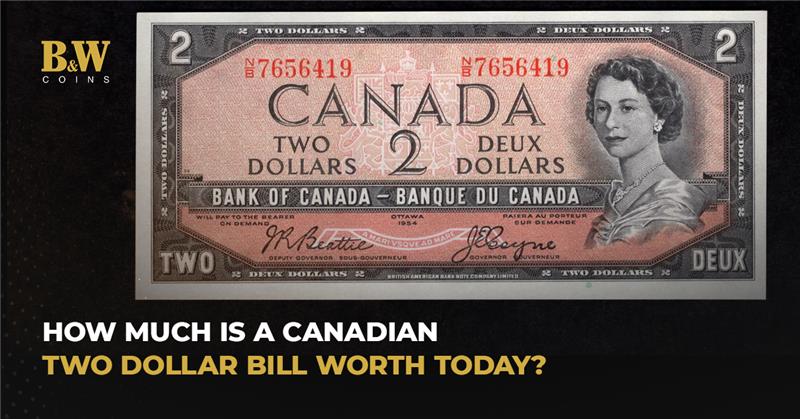
The Canadian two dollar bill value today has gained unexpected interest for a denomination that once lived in wallets, glove compartments, and corner stores. There are still a lot of Canadians who recall spending their money on candy or bus fare using the red paper note, and nowadays it finds its way back into the drawers, estates or family collections with a new question attached to it: What is it really worth now?
One of the reasons behind the curiosity is that the bill does not circulate anymore. Once something that is a common part of life is no longer needed in our daily life, then it is already not only money but already history. This is what happens at B&W Coins all too frequently, they have someone come in with a little stack of old bills, thinking that maybe they are just souvenirs, only to discover that old Canadian currency may have a collector value much better than face value.
A Short History of the Canadian Two Dollar Bill
The initial two dollar notes of the Bank of Canada went into circulation in the late 1930s, but did not actually get printed in large quantities until the later decades. The initial designs were royal portraits, elaborate engraving, and classical bi-lingual designs that now seem very mid-century and of great collector value. These pioneer survivors are now squarely in the vintage Canadian bills category.
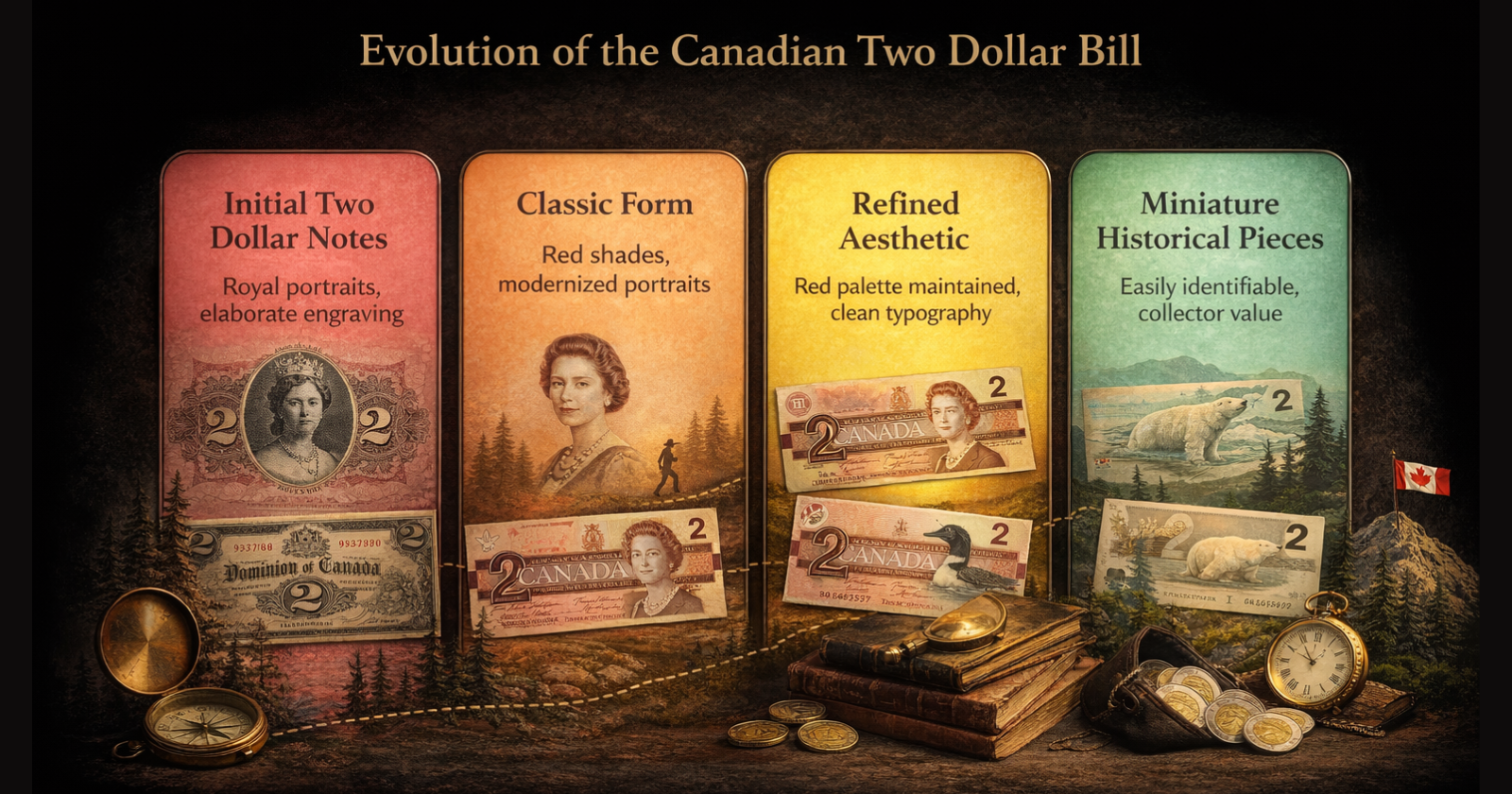
The two dollar note assumed its classic form in the 1950s/1970s: luxurious red shades, modernized portraits of Queen Elizabeth II and clean typography of the time. The aesthetic was further refined later, but the palette was kept to a red; this made the bill easily identifiable. Visitors to B&W Coins frequently refer to these notes as miniature Canadian historical pieces of money.
When the $2 Bill Was Discontinued and Why It Still Matters
The Bank of Canada stopped the use of paper notes in 1996 and introduced two dollar coins to replace it. The impetus behind the switching was to a large extent cost and durability: polymer and metal have a much extended life compared to paper, particularly in low denominations where hands are changed at a frequent rate. It was a smooth move to the toonie and a silent departure of the paper note.
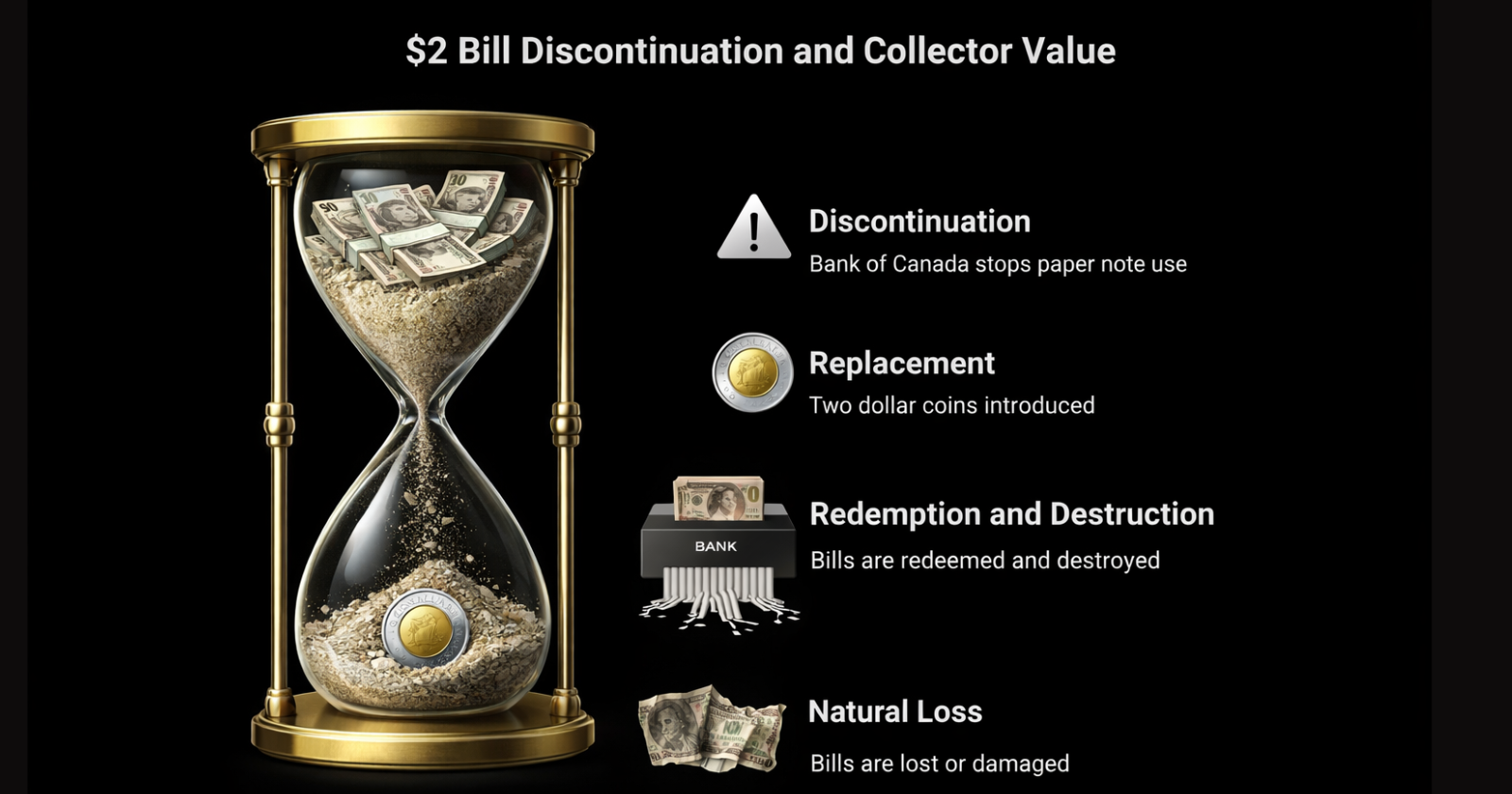
It is important that discontinuation exists since boundaries are valued by collectors. After a note ceases circulation, the population surviving is reduced by redemption and destruction and natural loss. In due course, there are fewer bills that are in collectible conditions. We can witness this dynamic at B&W Coins; we will have fewer high-grade examples every year, and the dwindling supply stabilized premiums in the collector market, which are long term.
Canadian Two Dollar Bill Value Today: What Is It Worth?
Our most frequent question is simple, and that is, how much are the two dollar bills in Canada nowadays? In the case of circulated notes of the 1986 series of the series Scenes of Canada, the majority of the notes are exchanging between the three and six dollar mark depending on the condition of the note. Crisp uncirculated notes are far higher, usually between twelve and twenty five dollars with premiums on some of the serial blocks and printing particulars commonly seen across Canadian paper money and banknotes tracked by collectors.
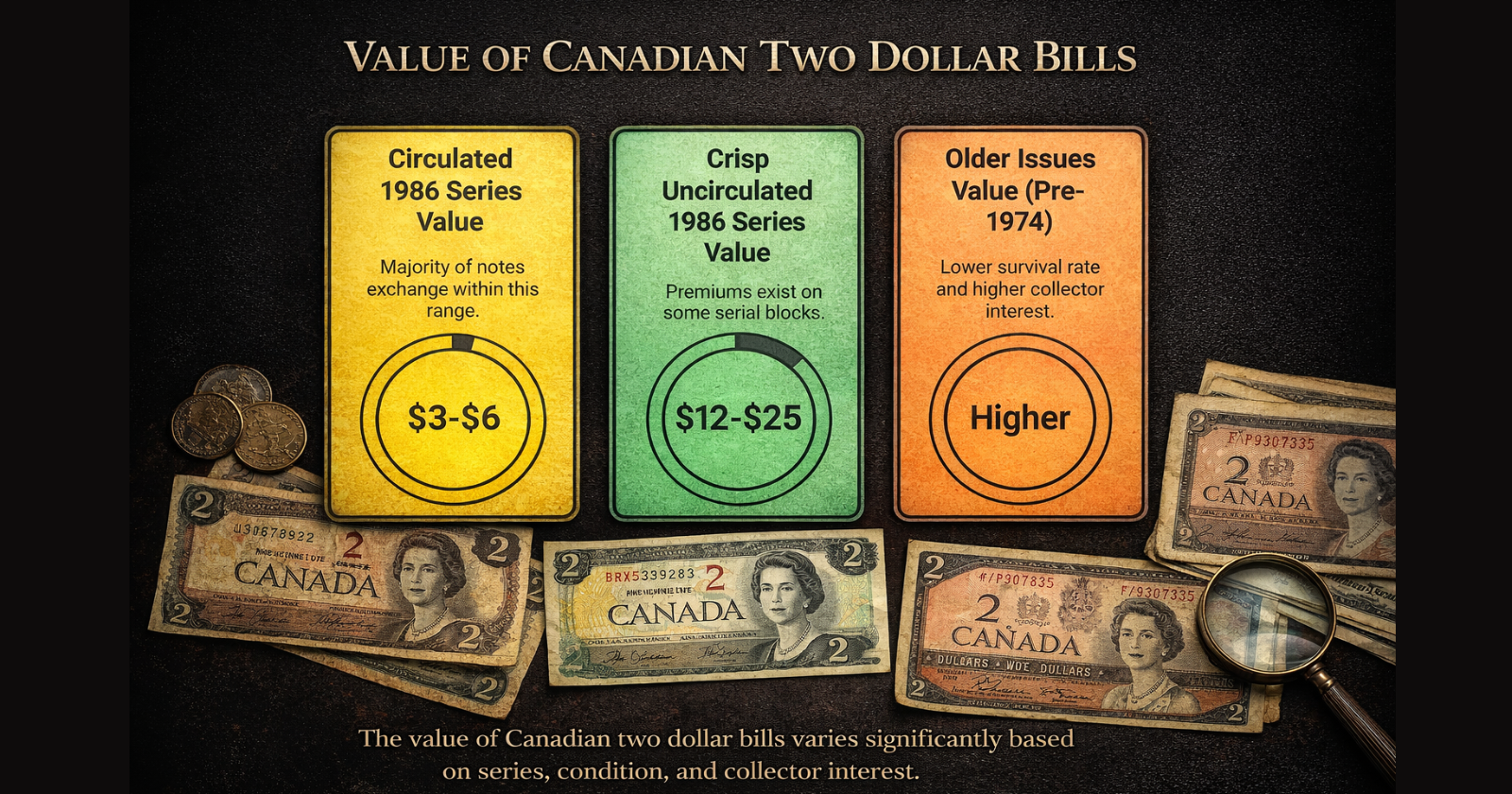
Older issues, particularly those published before 1974, will attract a higher price due to a lower survival rate and a higher rate of interest by the collector. The consistency that we have been able to find about the condition is the extent to which it changes value dramatically at B&W Coins. Two notes which look similar to the naked eye can vary greatly when examined in a proper Canadian banknote appraisal particularly in comparison with numismatic standards.
Which $2 Bills Have the Strongest Collector Interest?
There are three periods that are likely to draw the most collector interest, namely the 1954 Devils Face notes, mid-century Queen Elizabeth II notes, and the 1986 series with replacement notes that are scarce and low-print blocks. Devil Face type of variety is exceptionally sought after as the portrait engraving had inadvertently revealed a spill over in the hair of the Queen and thus redesign was done and a window was set to print it.
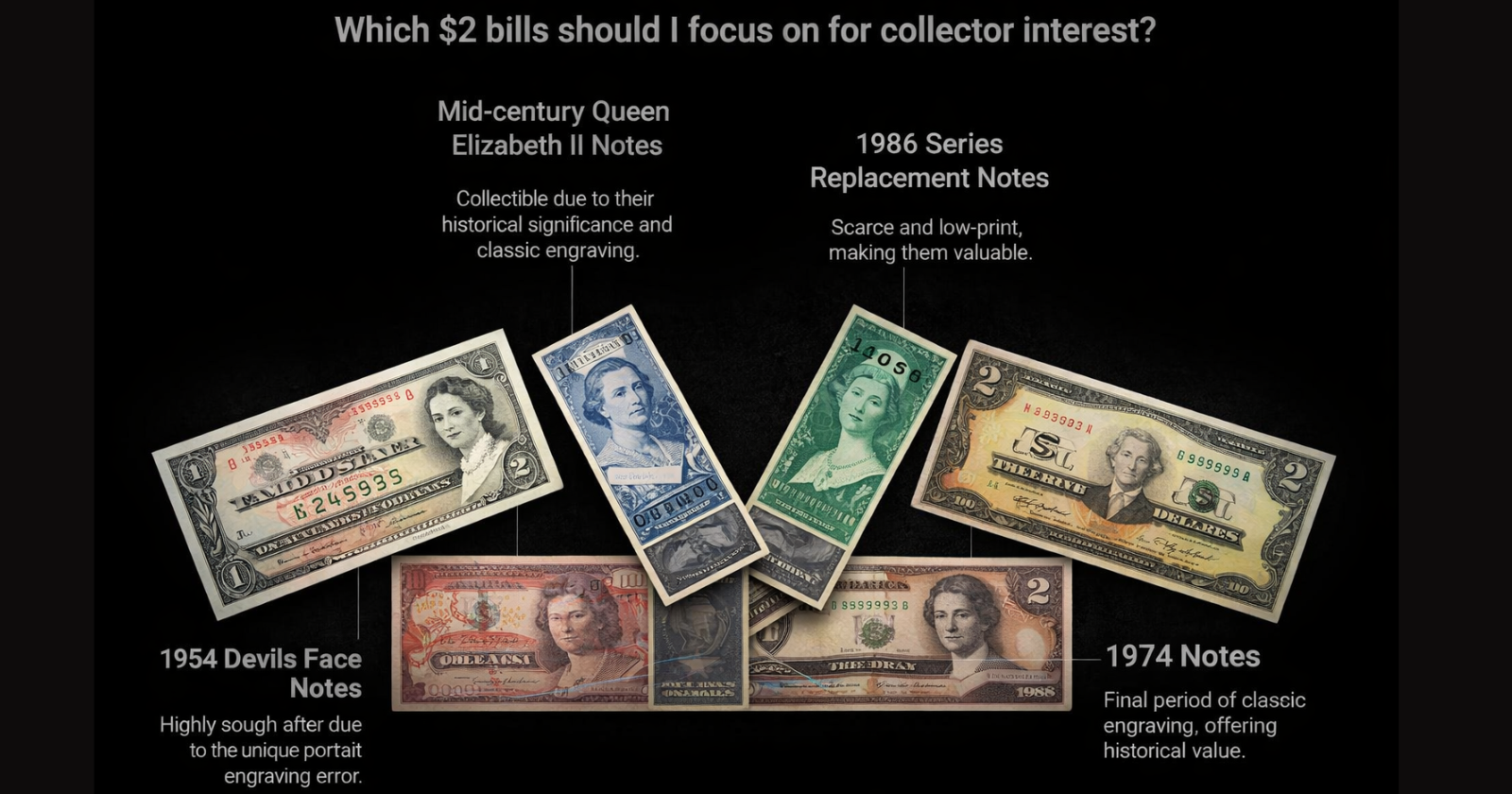
The issues published in 1974 and 1986 were of interest due to various reasons. The 1974 notes are the final period of classic engraving preceding the change of printing to more modern language of visual representation. The 1986 notes have the advantage of being old; they are not so old that they are collectible but not so new that they remain in estates. A large number of such discoveries are presented to B&W Coins to be appraised.
How Much Is a 1986 Canadian Two Dollar Bill Worth?
The most popular note in the eyes of contemporary collectors was the 1986 note because it brought the fewest inquiries, simply because it was the last paper note before the toonie started to be used and formed part of the Birds of Canada banknotes series. Most 1986 bills in the circulated condition are retailing between three and six dollars. Uncirculated may vary between twelve and twenty five dollars based on printing variation, rate of survival and collector demand.
Substitute notes, low note numbers and radar patterns can add value even more. And when someone is taking in a pile of 1986 bills to be evaluated at B&W Coins, the majority of the base notes get placed in the humble area, yet the replacement note or special serial pattern will alter the conversation altogether. It is these differences that make informed appraisal an issue.
Why Condition and Printing Variants Matter So Much
Standardized numismatic grading of old Canadian paper money consists of methods of assessment of folds, margin wear, ink quality and paper originality. A note kept in a wallet and years folded takes quite a different trend compared to a note kept in an album stored flat. Customers who bring their coins to be appraised at B&W Coins frequently become shocked at the difference in value between a nice and uncirculated coin, just to mention a few.
There is an added complexity of printing variations. Combination of signature, block of production, prefix replacement and anomaly printing can form a tiny bubble of rarity that can raise the Canadian two dollar bill collector value above the expected base. It is these differences that make the difference between ordinary survivors and uncommon Canadian banknotes that fetch high bids on the auction block or in a one on one deal.
Appraising Two Dollar Bills in Today’s Market
The appraisal of the paper two dollar bill Canada is pegged on three main factors, which include the survival numbers, collector demand, and condition. The process of discontinuation limits supply and the demand is increasing slowly with the attraction of new hobbyists with the help of nostalgia. Most of the Canadians who visit B&W Coins are not the traditional collectors; they just want to know whether what they have discovered is valuable.
The variable that is the most influential is condition. Even when the difference is intangible, a note that has been graded as about uncirculated can outdo a very fine specimen by several folds. This is the reason why most individuals prefer to get their Bank of Canada two dollar bills assessed by professionals instead of depending on the pictures shown online or unprofessional guesses.
Where the Market Goes from Here
Surviving material decline and historical interest increase, the overall market of the Canadian currency discontinued trends is heading upwards. The bill of two dollars occupies a very attractive market position: it is neither too new nor too old. This is an easy gateway of newer collectors and even estate sellers.

B&W Coins has also seen a consistent number of requests by families to settle estates, hobbyists reentering the world of numismatics, and people just finding old bills as they sort personal possessions. Such trends generally reinforce markets in the long term, not by speculation, but by making things that were previously a matter of course to be experienced as national historical artifacts.
Conclusion: Why Appraisal Matters and What to Do Next
To a great number of Canadians, the rediscovery of the old red two dollar bill is an incident of curiosity that quickly turns into an educational experience. Something that used to be commonplace has now passed over to the collector realm not just because it is no longer in circulation, but because it represents more of a Canadian currency history that is no longer easily present in everyday life.
The value is conditional on minor variations which are not always immediately visible – the printing variations, the condition, the signature combinations, the survival rates all carry weight. This is the reason why individuals tend to carry notes to B&W Coins instead of thinking that they have no value beyond the face of it. Sometimes they are. Sometimes they are not. The distinction is in adequate assessment.
B&W Coins assists the collector, estate, and family of knowing the real market value of the money of the Canadians today. An appraisal gives one a solution and a sense of security, whether he or she decides to add to a collection, sell on the low profile or just find out what he or she has. When you have money in the form of Canadian 2-dollar bills (in a handful or in a whole album), B&W Coins will never turn you away.
FAQ
How much is a Canadian two dollar bill worth today?
The higher circulated 1986 notes are between three to six dollars with uncirculated notes ranging between twelve to twenty-five dollars. Older problems may outweigh such values according to rarity and condition. Appraisal assists in establishing the position of a note in the market.
Are Canadian two dollar bills still worth money?
Yes. They are still redeemable at face value and can sell on collector markets at more than face value. In the B&W Coins, we have the situation of bills selling higher than face based on discontinuations and collectorism.
What year Canadian two dollar bills are valuable?
Previous articles, like the 1954 notes about the Devil face are exceptionally in demand. There are also premiums in high grade or special serial numbers in the 1974 and 1986 issues. Correct evaluation helps in defining the category, in which a note belongs to.
Is a 1986 Canadian two dollar bill worth anything?
Bills that are in circulation with premiums of 1986 below the face value and can fetch high prices are uncirculated notes or prefix replacement notes. A good number of the 1986 bills introduced in B&W Coins fall in this range.
How do I know if my Canadian two dollar bill is rare?
Rarity is dependent on variations of printing, sequences of serial numbers, and state. Features such as replacement notes, radar serials and early series engravings are examples of features that cause premiums. B&W Coins will be able to confirm that your bill will be treated as a common or a collectible one.