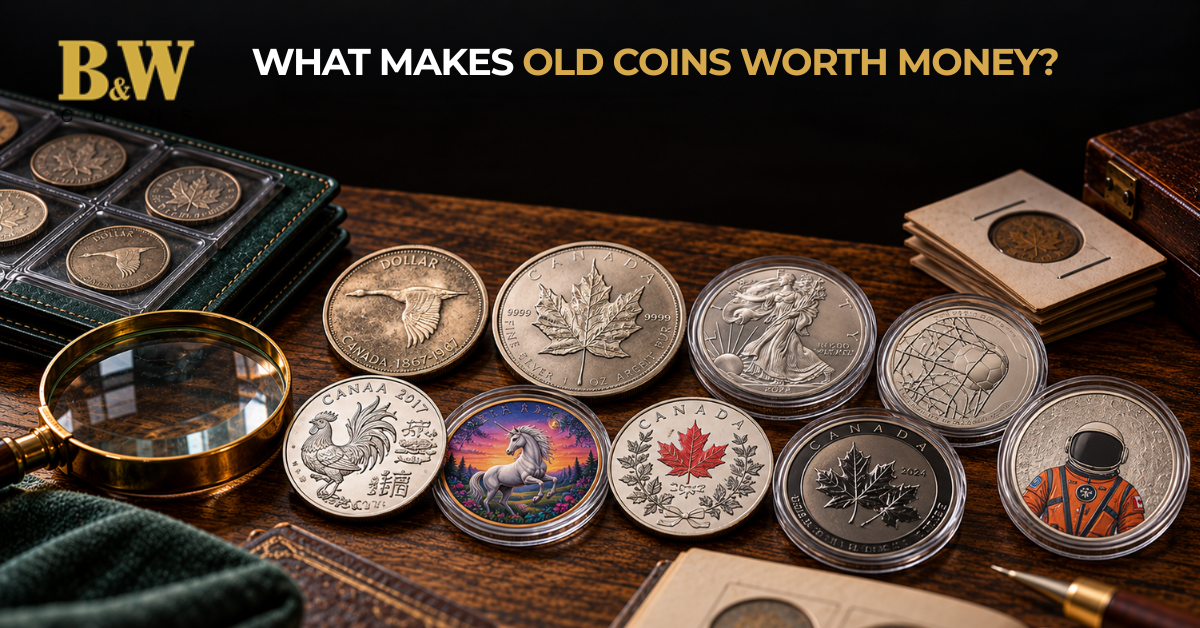
Someone walks into the shop with a jar of old coins. Another person brings an album from a parent’s closet. The question is almost always the same: “Are these worth anything?”
It is a fair question. Some coins are only worth face value. Some carry silver or gold value. A smaller group can bring more because of date, condition, rarity, or collector demand.
Here is the first thing we tell people. Old Canadian coin values are not based on age alone. An old coin can be common. A plain-looking coin can be much better. This guide covers what we check at the counter. Read it before you clean, sort, or sell anything.
Quick Answer: What Makes an Old Canadian Coin Valuable?
Value rarely comes from one detail. A dealer looks at several things together. That is why two coins that look alike can have very different prices.
Here is what usually matters for old Canadian coins worth money:
- Date
- Denomination
- Metal content
- Condition
- Rarity
- Variety
- Collector demand
- Original surface
- Grading or certification
- Complete sets or original holders
Most coins will not hit every point. Some hit only one or two. That is normal. The goal is to know which details apply to your coins.
Key insight: An old coin is not valuable just because it is old. Value usually comes from the full picture: date, condition, metal content, rarity, and buyer demand.
Age Helps, But It Is Not Enough
Many people assume old means valuable. Sometimes it does. Often it does not. Plenty of old coins were made in large numbers, and many survived.
Age can help because older coins are harder to find in good shape. But if many exist and few collectors want them, the old coins value stays modest.
Condition can change everything. Two coins from the same year may sit far apart in price. One is worn and scratched. The other has sharp detail and natural surfaces.
The reverse happens too. A newer-looking coin can be the better one, thanks to a low mintage or a strong variety.
What a Dealer Checks First
A dealer does not start with price. The first step is identification. We need to know exactly what the coin is before we say anything about value.
| What to Check | Why It Matters |
|---|---|
| Date | Some years are common, while others are harder to find. |
| Denomination | Cents, nickels, dimes, quarters, halves, and dollars have different markets. |
| Metal content | Some older Canadian coins contain silver or gold. |
| Condition | Wear, scratches, cleaning, and damage can change value. |
| Variety | Small design differences can matter to collectors. |
| Demand | A coin is worth more when buyers are actively looking for it. |
| Authenticity | Better coins should be checked carefully before pricing. |
This is why a quick online search can mislead people. The price you find may be for a cleaner coin, a rarer variety, or a certified example. It may not match what is in your hand.
Silver Content Can Create a Value Floor
Some old Canadian silver coins are worth checking for silver content. Older dimes, quarters, half dollars, and silver dollars may be worth more than face value. It depends on the year and the composition.
Think of it as two types of value. Melt value is what the metal is worth. Collector value is what a buyer pays for the coin itself.
A worn, common silver coin often trades close to metal value. A better date or higher-grade coin can bring more. Silver prices move daily, so we do not quote fixed numbers here.
Dealer takeaway: Silver content can create a value floor, but it does not tell the whole story. A better-date or higher-condition coin may be worth more than metal value alone.
If you want to see how silver pieces are described, browse our silver coins.
Condition Is Often the Difference
Coin condition is one of the biggest reasons Canadian coin values vary. A heavily worn coin can still be collectible. But it is usually not valued like a sharp, well-kept example.
Collectors often check:
- Surface marks
- Scratches
- Cleaning
- Rim damage
- Detail sharpness
- Natural toning
- Lustre
- Eye appeal
Cleaning is the mistake we see most. People polish coins because shiny looks better. In coin collecting, it often does not.
Key insight: Cleaning can make a coin look brighter, but not always better. In many cases, cleaning reduces collector interest because it changes the original surface.
If you do not know what you have, do not clean it. Leave it as it is. Let someone review it first.
Grading Can Matter, But Not Every Coin Needs It
Coin grading is a way to describe condition. In Canada and the U.S., many graders use the 1–70 Sheldon scale. A certified coin comes in a sealed holder with a grade, so buyers feel more confident.
Grading helps most when a coin is scarce, high grade, valuable, or often counterfeited. In those cases, certification can protect the coin and make its value easier to understand.
But not every coin is worth grading. For common coins in average shape, the fee may cost more than the coin gains. If you are curious how certified pieces look, see our graded Canadian coins.
So skip the question “Should I grade everything?” Ask this instead: “Which coins are worth a closer look?”
Why Online Prices Can Be Confusing
Online prices can help, but they can also mislead. A listed price is not always a sold price. Anyone can ask for any amount.
Many people also compare their coin to the wrong example. They find a similar-looking coin online and assume it matches. One small variety or surface issue can change the value a lot.
When you check old coins value online, compare carefully:
- Same country
- Same denomination
- Same year
- Same variety
- Same grade
- Same condition
- Sold results, not only asking prices
Dealer takeaway: A high online asking price does not always mean market value. The best comparison is a similar coin, in similar condition, that actually sold.
Old Coin Collections Should Be Reviewed Together
If the coins came from a family member or an estate, keep them together at first. An inherited coin collection often tells a story. The way it was built can matter.
Please do not pull out the “good” coins too quickly. At the counter, we often find the better pieces are not the ones people expected. Pulling coins early can break up sets and lose context.
Old envelopes, albums, holders, boxes, receipts, and handwritten notes can all help. They show where coins came from and how they were stored. Sometimes the value sits in the group, not one coin.
If you want a second opinion, a coin collection review works best when the full group is there.
What Not to Do Before Finding the Value
Most mistakes happen before the coins reach a dealer. This old coin value checklist keeps you safe:
- Do not clean coins
- Do not polish silver
- Do not remove coins from holders too quickly
- Do not throw away boxes or notes
- Do not tape damaged holders
- Do not assume every old coin is rare
- Do not sell one piece before reviewing the group
- Do not rely only on one online price
The safest step is simple. Keep everything together. Handle the coins as little as possible.
Key insight: If you are unsure what you have, leave everything as it is. A coin dealer can review the collection better when the original holders, notes, and groups stay together.
When Should You Ask for a Coin Review?
You do not need to know everything first. A good review helps sort what is common, what is collectible, and what needs a closer look.
You should consider a coin review if:
- You inherited a coin collection
- You found old Canadian coins at home
- You see silver coins in the group
- You notice graded coins or holders
- You have older albums or sets
- You see coins from the 1800s or early 1900s
- You are unsure if coins were cleaned
- You want to understand value before selling
B&W Coins is located in Brampton and helps customers from Toronto, Mississauga, the GTA, Ontario, and across Canada review old Canadian coins and coin collections. If you are thinking about it, you can also read how to sell coins with us.
Final Dealer Advice
Old Canadian coin values are shaped by more than age. The real value comes from the full picture: date, denomination, metal content, condition, rarity, demand, and authenticity.
Some coins are simple. Some need closer review. Some are worth keeping. Others are better sold as part of a group.
If you are not sure what you have, slow down. Do not clean, separate, or sell anything yet. If you have an old coin collection and want clearer guidance, B&W Coins can help review the group and explain what details may matter before you decide what to do next. Start with an old coin collection review.
FAQs About Old Canadian Coin Values
Are old Canadian coins always valuable?
No. Many old Canadian coins are common and carry modest value. Others are worth more because of silver content, rarity, condition, variety, or collector demand. Old Canadian coin values depend on the full picture, not age alone.
What is the best way to check old coins value?
Start by identifying the date, denomination, metal content, and condition. Then compare your coin with sold examples in the same grade. For better coins or full collections, a dealer review gives clearer answers.
Should I clean old Canadian coins before selling or reviewing them?
No. Cleaning can reduce collector appeal and make a coin harder to evaluate. Keep the coin in its current condition until someone has reviewed it.
Do Canadian silver coins have more value?
Often, yes. Some older Canadian silver coins are worth more than face value because of metal content. Collector value can be higher still when the coin has a better date, strong condition, or a special variety.
Is grading worth it for old Canadian coins?
Sometimes. Grading helps with scarce, high-grade, or valuable coins. Common coins in average condition may not justify the fee. A dealer can tell you which coins are worth sending.