Milk spots can make a beautiful Silver Maple Leaf coin look less appealing, even though the silver content hasn’t changed. Here’s what these spots actually mean, and what to check before you buy.
A Silver Maple Leaf coin can look perfect at first glance. Then you notice a cloudy white mark.
That small spot can raise real questions for buyers: Is the coin damaged? Is it still worth buying? Will another collector care later? The answer is not always simple. Milk spots do not automatically make a coin fake or worthless, but they can affect eye appeal, buyer confidence, and the price a person feels comfortable paying.
That is why milk spots matter not because every spotted coin is bad, but because the condition should always match the purpose and price of the coin.
What Are Milk Spots on Silver Maple Leaf Coins?
Milk spots are cloudy white marks that can show up on the surface of silver coins. They look like small patches or dots sitting just under the shine. They’re a surface and appearance issue, not proof that a coin is damaged or low quality.
You’ll notice them most on bright, clean coins like the Silver Maple Leaf, simply because there’s nothing else on the surface to hide them.
Real collector discussions show the same concern: once white spotting appears, buyers start questioning storage, minting, condition, and whether the coin is still worth the same.
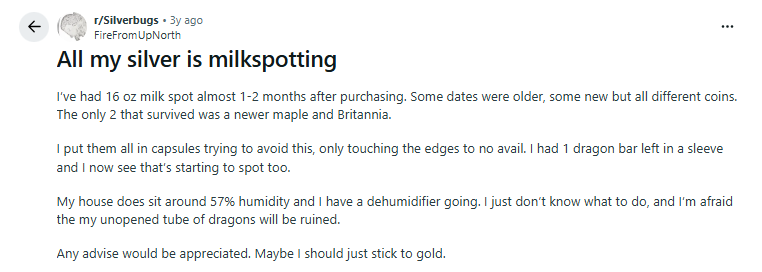
Source: Reddit discussion on silver milk spotting
Helpful note: A milk spot does not automatically mean the coin is fake. It just means you should look closer at the coin’s condition and price before deciding.
Why Buyers Notice Milk Spots So Quickly
People often buy Silver Maple Leaf coins because they are clean, recognizable, and easy to compare. The design is simple, the silver content is clear, and the coin has a strong Canadian identity.
That clean look is also why milk spots are so noticeable. A buyer may not care about a tiny mark on a heavily circulated coin. But on a bright silver coin, even one cloudy patch can catch the eye.
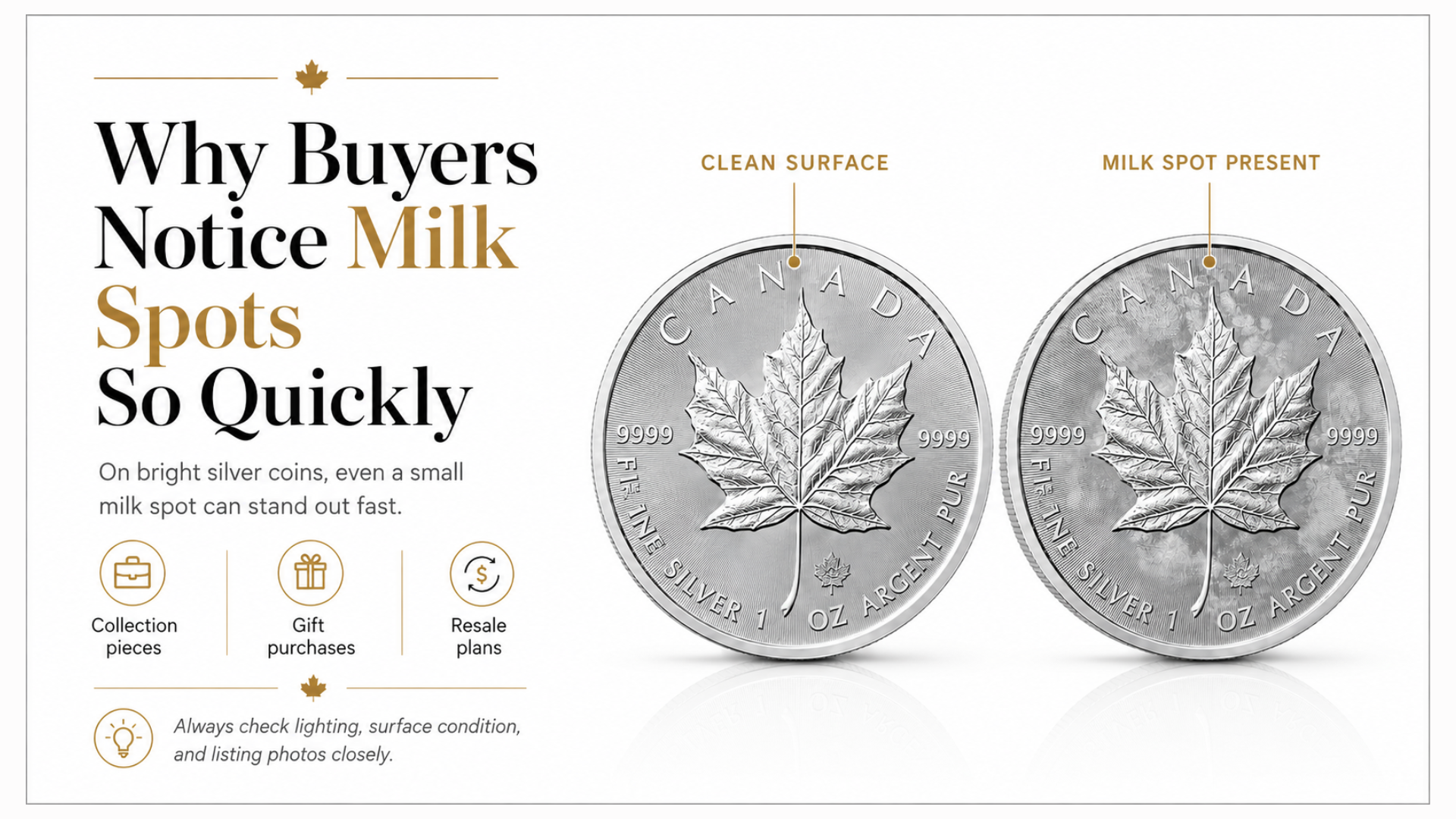
Buyers usually notice milk spots faster when they are buying for:
- A personal collection
- A gift
- A display piece
- A cleaner bullion example
- A coin they may resell later
Photos can also be tricky. Some milk spots are easy to see in person but harder to notice in online images. This is why serious buyers should look beyond the first photo. Check surface condition, lighting, and product details before making a decision.
Key insight: Milk spots are not always a silver-content problem, but they can become a buyer-confidence problem when the coin is being compared against cleaner examples.
Do Milk Spots Affect the Silver Value?
In most cases, milk spots do not change the silver content of a Silver Maple Leaf coin. The coin can still contain the same amount of silver. But silver value and collector appeal are not always the same thing.
A buyer looking only at silver content may care less about a small spot. A collector, gift buyer, or condition-focused buyer may care much more. That is where price becomes important.
A coin with visible milk spots should not always be compared the same way as a cleaner coin. If the surface condition is different, the asking price should make sense too.
For many buyers, the real question is not:
- “Does this coin still contain silver?”
The better question is:
- “Does the condition match the price I am paying?”
That is the way a careful buyer should think.
Real buyer concern: In collector discussions, milk spots often lead to the same question- does the coin lose silver value, or does it mainly affect how buyers judge condition and appearance?

A Reddit discussion showing how silver buyers ask whether milk spots affect resale value, dealer interest, and the difference between silver content and surface appearance.
This is the important point: the coin may still contain the same silver, but a cleaner example can feel easier to compare, price, and resell.
How Milk Spots Can Affect Collector Appeal
Collector appeal is about more than metal content. It also includes how the coin looks, how clean the surface is, and how confident another buyer may feel about it later. Milk spots can reduce that appeal.
A coin with strong shine and clean surfaces usually feels easier to compare. A coin with cloudy patches may still be genuine, but it may not attract the same attention from condition-sensitive buyers.
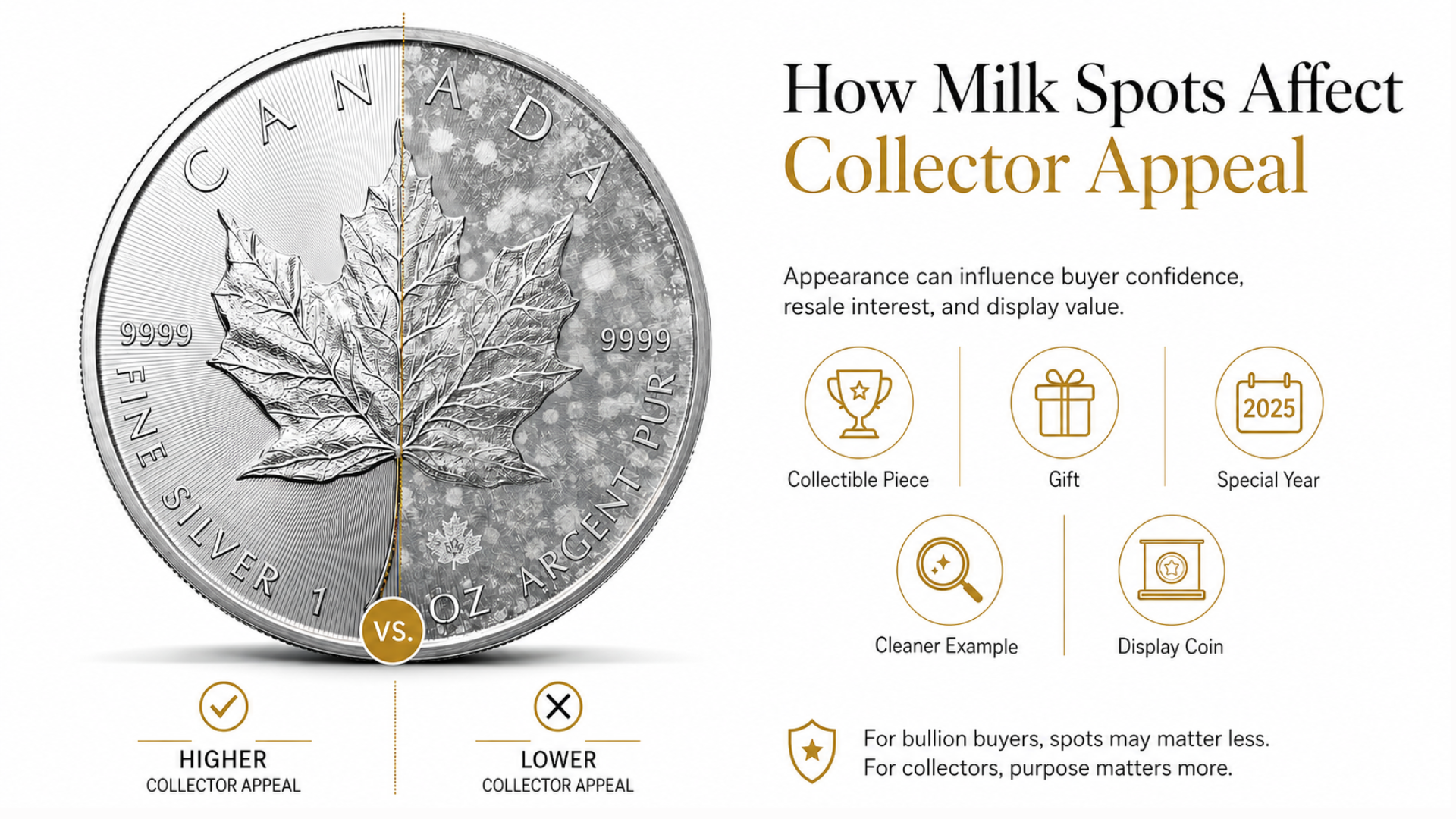
This matters more when the coin is being bought as:
- A collectible piece
- A gift
- A special year
- A cleaner example
- A display coin
It may matter less when the buyer simply wants a recognized silver bullion coin. That is why purpose matters. A Silver Maple Leaf coin with milk spots may still be fine for one buyer and less suitable for another.
Practical insight: A coin can be genuine, recognized, and still contain silver, but visible spotting may change how buyers compare it against cleaner examples.
How Milk Spots Can Affect a Silver Maple Leaf Coin
Buyer Situation | What Milk Spots May Change | What They Usually Do Not Change | Dealer Advice |
Buying mainly for silver content | May make the coin less attractive, but not always a major issue. | The coin’s silver weight and purity usually stay the same. | It may still be a fair buy if the price reflects the surface condition. |
Buying for a collection | Can reduce eye appeal and make the coin less desirable beside cleaner examples. | It does not automatically make the coin fake or worthless. | Choose the cleaner coin if the price difference is small. |
Buying as a gift | Can affect presentation because white spots are easy to notice on bright silver. | The coin can still be genuine silver. | For gifting, a cleaner coin is usually the better choice. |
Buying for future resale | May make some buyers offer less or choose a cleaner coin instead. | It does not remove the coin’s silver content. | Avoid paying clean-coin pricing for a coin with obvious spotting. |
Buying a special date or version | Spotting may matter less if the coin has stronger collector interest. | The date, issue, and silver content still matter. | Judge the full coin: date, condition, demand, and price together. |
Dealer takeaway: Milk spots usually do not change the silver inside the coin. What they can change is buyer confidence, eye appeal, and how fairly the coin should be priced compared with a cleaner example.
Are Milk Spots a Sign of a Fake Coin?
No. Milk spots alone do not mean a Silver Maple Leaf coin is fake. This is one of the most common concerns buyers have when they notice white marks on a coin. While milk spots can affect appearance, they are not considered a reliable way to judge authenticity.
A real coin can have surface issues. A fake coin can also look clean. That is why authenticity and condition should be evaluated separately. Milk spots are a condition of concern, not proof that a coin is genuine or counterfeit.
Before buying, it is worth checking:
- Weight
- Diameter
- Thickness
- Edge reeding
- Design sharpness and detail
- Magnet response (silver is not magnetic)
- Seller reputation
- Clear product descriptions and photos
Experienced buyers focus on the complete picture rather than a single surface mark. A genuine coin can develop milk spots over time, while a counterfeit coin may appear flawless at first glance.
Many first-time buyers worry that a milk spot means the coin is fake. In practice, experienced buyers usually treat milk spots as a condition issue and verify authenticity through weight, dimensions, design details, and the seller’s reputation.
What to Check Before Buying a Silver Maple Leaf Coin
Before buying a Silver Maple Leaf coin, take a few minutes to check the details. A quick look can help you avoid paying too much for a coin that does not match your purpose.
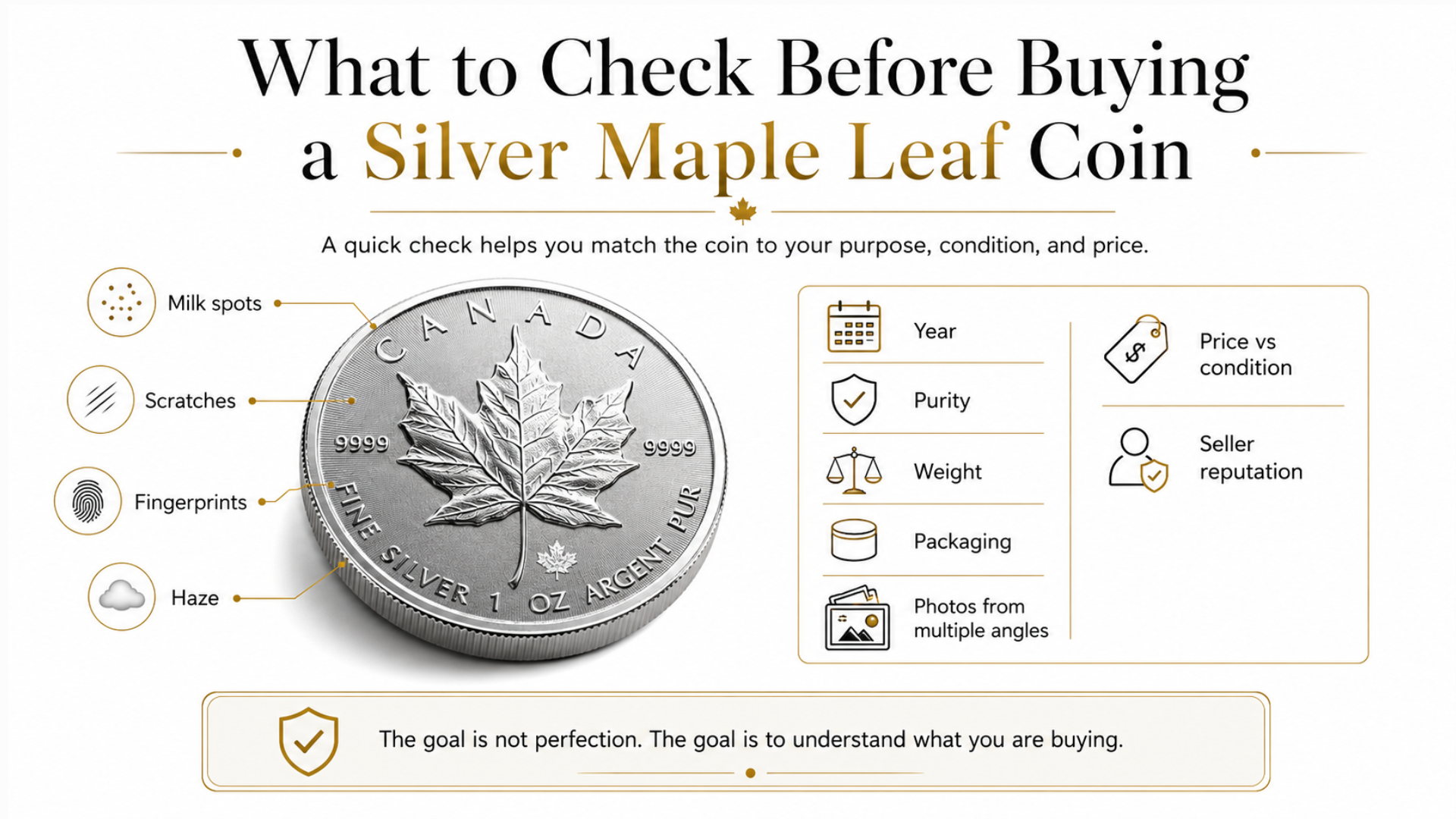
Start with the surface. Look at the coin under good light. Rotate it slightly if possible. Milk spots, haze, scratches, and fingerprints may appear differently from different angles. Then compare the product details.
A careful buyer should check:
- Milk spots or cloudy patches
- Scratches or handling marks
- Fingerprints
- Haze or dull areas
- Year of issue
- Silver purity
- Coin weight
- Packaging or capsule
- Photos from more than one angle
- Price compared to condition
- Seller reputation
The goal is not to find a perfect coin every time. The goal is to understand what you are buying. A coin bought for silver holding may not need to look flawless. A coin bought as a gift or collectible should usually be cleaner and better presented.
Key insight: Condition should be judged with purpose. A coin for stacking, gifting, and collecting may not need the same surface quality, but the price should always reflect what you are getting.
Should You Avoid Every Coin With Milk Spots?
No. You do not need to avoid every Silver Maple Leaf coin with milk spots. Some spotted coins can still be reasonable buys, especially when the buyer mainly wants silver content and the price reflects the surface condition.
But you should be careful. If a coin has visible milk spots, ask yourself:
- Am I buying it for silver content?
- Am I buying it as a gift?
- Am I buying it for a collection?
- Is the spot small or heavy?
- Is the price fair for the condition?
- Would I still be happy with it later?
If you are buying for a gift, a cleaner coin may be better. If you are buying for a display collection, eye appeal matters more. If you are buying for silver exposure, small spots may matter less. The main mistake is paying cleaner-coin pricing for a heavily spotted coin.
That is where buyers can go wrong. A spotted coin is not automatically a poor choice. It just needs to be priced and judged honestly.
Final Buying Advice Before You Choose
Take a moment to look at the coin in good lighting before deciding. Spots can be easy to miss in a quick glance or a small photo. Ask questions if you’re unsure. A trustworthy seller won’t mind explaining a coin’s condition.
Don’t rely only on stock photos when buying online. Actual conditions can vary coin to coin, even within the same listing. Choose based on your purpose, whether that’s stacking, gifting, or collecting. At B&W Coins, we help buyers compare Silver Maple Leaf coins by condition, year, design, and presentation, so you know exactly what you’re choosing before you decide.
Frequently Asked Questions
Are milk spots common on Silver Maple Leaf coins?
Milk spots can appear on Silver Maple Leaf coins and other silver coins. They usually show as white marks, cloudy patches, or light haze on the surface. They are mostly an appearance concern, not automatic proof of a fake coin.
Do milk spots lower the value of a Silver Maple Leaf coin?
They can affect buyer interest, especially for collectors, gift buyers, or anyone comparing condition. The silver content may still be the same, but visible spotting can reduce eye appeal and affect what another buyer is willing to pay.
Can milk spots be removed from silver coins?
It is usually better not to clean, rub, or polish silver coins. Cleaning can create scratches or surface damage. In many cases, trying to remove a spot can hurt collector appeal more than the original mark.
Should I buy a Silver Maple Leaf coin with milk spots?
It depends on your goal. If you mainly want silver content and the price reflects the condition, it may still make sense. If you want a clean collectible or gift, a better-looking coin may be the stronger choice.
Do milk spots mean a Silver Maple Leaf coin is fake?
No. Milk spots alone do not mean the coin is fake. Authenticity should be checked separately through weight, size, edge detail, design quality, and seller trust.